Attractiveness Scale: What a 1-10 Score Really Means
Learn what an attractiveness scale measures, how to read a 1-10 rating, why photo quality changes the score, and how to use it as feedback.
Written by
Clara Vale
Beauty technology writer focused on making AI face-rating language clearer, safer, and more useful for photo feedback.
Editorial Note
Updated on October 9, 2026 after reviewing recent search data around the attractiveness scale.
The short answer
An attractiveness scale summarizes how a face or photo is perceived, often from 1 to 10. A higher number usually means the specific image looks clearer, more balanced, or more conventionally attractive to the system or rater. For score attractiveness guidance, treat the number as photo feedback and ask which image is most useful for your goal.
An attractiveness rating is not a permanent label. Lighting, camera distance, angle, expression, grooming, and image quality can change the result. Use the scale to compare similar photos, not to define your whole appearance.
What an attractiveness scale measures
When people ask is there a scale for attractiveness, they usually want a simple way to interpret a complicated visual impression. A 1-10 scale compresses symmetry, feature spacing, expression, grooming, photo quality, and model or rater preference into one number.
That is why two different systems can rate the same photo differently. A human rating may react to style, warmth, confidence, or personal taste. An AI attractiveness score usually reacts to visible image patterns such as landmarks, proportions, lighting, contrast, and framing. Neither can fully describe real-life attractiveness.
What a face rating may combine
- Visible facial balance: Spacing among the eyes, nose, lips, chin, and jaw can affect the overall impression.
- Symmetry and alignment: The model or viewer may reward faces that look centered and easy to read.
- Photo presentation: Lighting, crop, sharpness, and camera distance can shift the result even when the face is unchanged.
- Styling and expression: Hair, grooming, posture, and a natural expression can change perceived attractiveness.
- Rater bias: Every human or AI rating system reflects assumptions, preferences, and training data.
How AI beauty scores and face ratings are calculated
AI face-rating tools process an image, detect a face, estimate landmarks, and combine visible signals into a score or explanation. Those signals may include symmetry, proportions, feature visibility, skin texture, age cues, clarity, and framing.
Because the input is a still image, the score is really a photo score. A model cannot measure voice, movement, chemistry, humor, confidence, or daily-life presence, so an awkward selfie may score lower than a clear portrait of the same person.
For a broader scientific background on why facial beauty discussions often mention symmetry, averageness, and sexually dimorphic cues, this Annual Reviews overview of facial beauty is useful context. For a general overview of appearance-related attractiveness concepts, Wikipedia’s physical attractiveness article.
| Scale type | What it usually means | Best use |
|---|---|---|
| 1-10 attractiveness scale | A quick human-style rating that compresses many visual signals into one number. | Use it as a rough summary, not a precise measurement of personal worth. |
| AI beauty score | A model output based on visible landmarks, photo quality, symmetry cues, and learned patterns. | Useful for comparing photos when the input conditions stay similar. |
| Photo attractiveness rating | A score for one image rather than a stable score for the whole person. | The most practical use is choosing better profile or social photos. |
How to read 1-10 attractiveness scale ranges
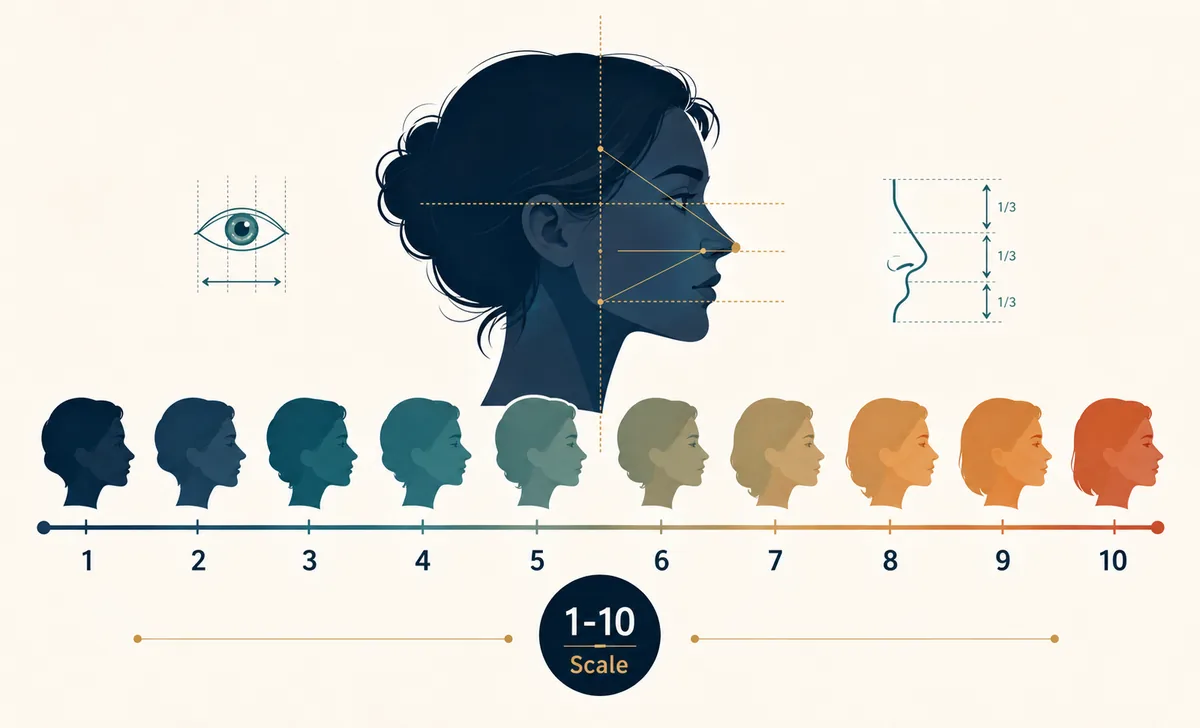
A 1-10 attractiveness scale looks precise, but it should be read in broad ranges. Small changes such as 6.8 versus 7.1 are rarely meaningful when the photo conditions are different.
The middle of the scale is sensitive to framing and light, so read broad ranges rather than small decimal differences.
Use the table as an interpretation guide, not a social hierarchy. Ask what the score says about the image and whether the pattern repeats.
| Variable | How it changes the score | Better practice |
|---|---|---|
| Lighting | Harsh shadows can hide facial landmarks and make symmetry look worse. | Use soft front light or bright indirect daylight. |
| Camera distance | A very close lens can enlarge the nose and midface while shrinking the sides of the face. | Step back slightly and crop the photo after taking it. |
| Head angle | Tilted or rotated faces are harder for AI and people to compare fairly. | Test one neutral front-facing image before testing stylized angles. |
| Expression | A tense expression can reduce perceived warmth and facial harmony. | Compare a neutral expression with a natural relaxed smile. |
| Filters and editing | Heavy smoothing or distortion may make the model read the face less reliably. | Use clear photos with minimal filters for the baseline score. |
Why an attractiveness rating changes between photos
An attractiveness rating can change between photos even when the person is the same. Lens distance, lighting, crop, camera height, expression, and face visibility often explain the difference before any deeper interpretation is needed.
Human raters are affected by the same presentation cues. Relaxed expression, clean framing, and good light can make a face feel more balanced, while a tense expression or distorted crop can make it harder to read.
For a fair comparison, upload one neutral front-facing photo and one realistic profile-style photo. If the numbers are far apart, inspect photo variables before drawing conclusions.
| Range | Typical interpretation | Better question to ask |
|---|---|---|
| 1-3 | Usually means the uploaded photo has severe quality problems or the model is reading weak visible signals. | Is the image dark, cropped, blurred, distorted, or blocked? |
| 4-5 | A lower-to-average result in that specific photo, often sensitive to lighting and expression. | Would a cleaner front-facing portrait change the result? |
| 6-7 | A generally positive score with readable facial structure and decent photo presentation. | Which photo variables could make the face read more clearly? |
| 8-10 | A high score for the image, usually reflecting strong clarity, balance, and presentation. | Is the score stable across several realistic photos? |
How to use a beauty score without overthinking it
The safest way to use an attractiveness rating is as feedback on a photo. Ask whether better lighting, cleaner framing, less distortion, or a natural expression would improve the image.
Avoid comparing unrelated systems as if they were standardized. One AI tool’s 8 may not equal another tool’s 8, and a forum score may reflect community norms. A photo app may reward polish and clarity more than facial structure.
A healthier score-reading workflow
- Use one clear baseline photo: Start with even lighting, a front-facing view, and minimal filters.
- Compare similar images: Change one variable at a time, such as lighting or expression.
- Look for patterns: A repeated trend across photos is more useful than one isolated number.
- Read the explanation: Feature notes and photo-quality feedback often matter more than the final score.
- Keep the number proportional: Treat it as image feedback, not a verdict on dating, confidence, or identity.
Attractiveness scale vs. attractiveness test
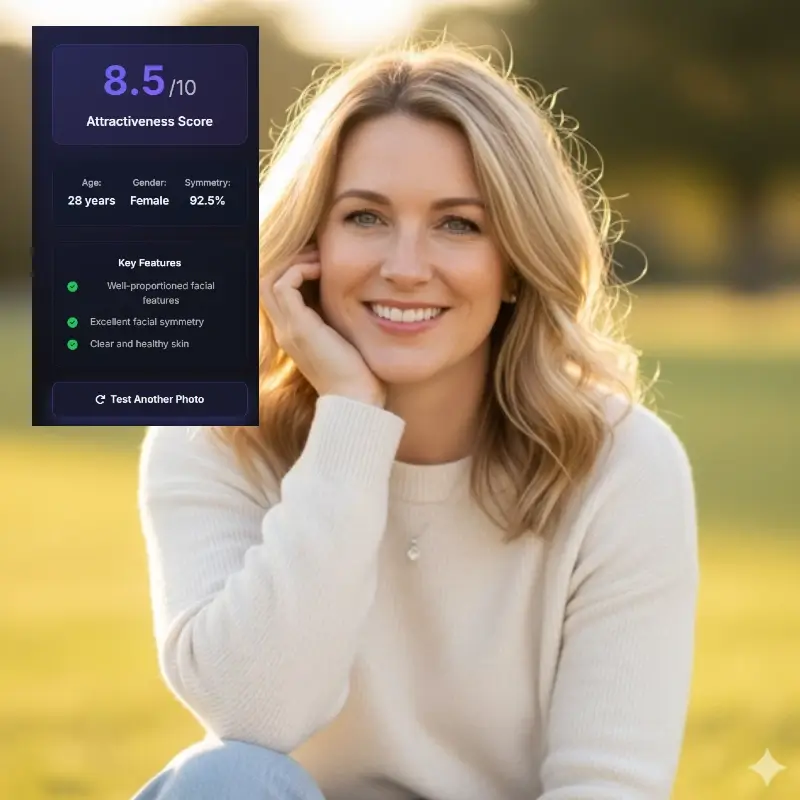
An attractiveness scale explains the result, while an attractiveness test performs the photo-based task. Use this guide for interpretation, then follow the existing tool link when you want to upload a portrait and compare results.
The scale guide explains interpretation; the free test and Face Rating AI pages handle photo scoring.
Which page fits your goal?
- Want a fast score: Use the free attractiveness test on the homepage.
- Want profile-photo feedback: Use Face Rating AI and compare similar portraits.
- Want PSL terminology: Read the PSL score guide before interpreting strict internet ratings.
- Want proportion context: Use the facial harmony and canthal tilt guides for specific feature concepts.
FAQ about the attractiveness scale
Ready to test a photo after learning the scale?
Use the attractiveness scale as a reading guide, then upload a clear portrait to see how the AI interprets it. Compare two similar photos and notice what changed.
For context, pair your result with Face Rating AI and the PSL score guide to separate photo feedback from harsher internet rating language.
References and context
- Rhodes, G. (2006). The Evolutionary Psychology of Facial Beauty. Annual Review of Psychology.
- Background: symmetry, photo conditions, and cultural variation.