Upload one clear photo
Start with a front-facing selfie or portrait where your eyes, nose, lips, and jawline are easy to see. Cleaner images usually produce more stable AI face rating results.
Upload a clear selfie to get an AI face rating, a simple face score, facial symmetry feedback, and practical guidance for choosing better profile photos.


Use a clear front-facing selfie, or drag and drop an image here
See the kind of polished portraits that usually give the tool a cleaner read.
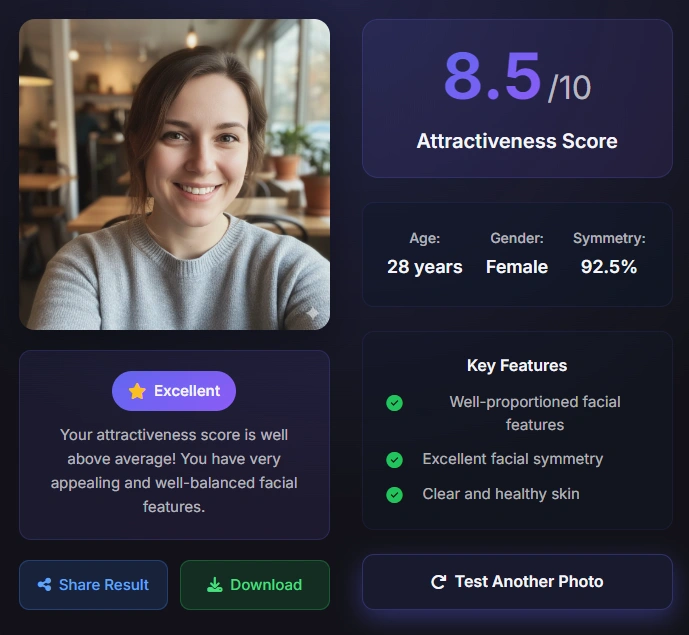
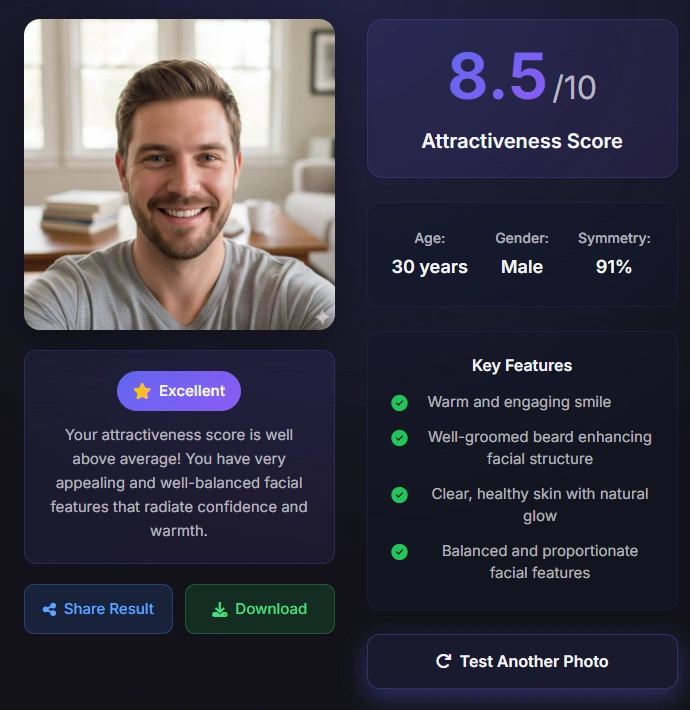
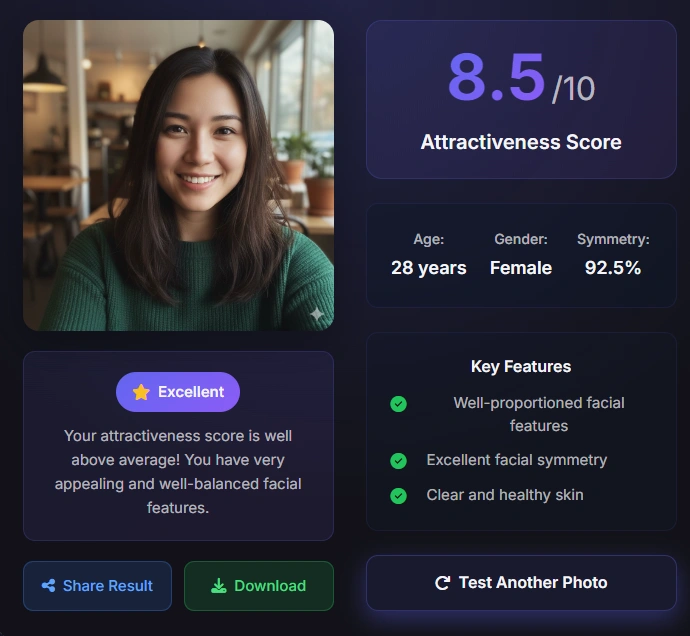
Start with a front-facing selfie or portrait where your eyes, nose, lips, and jawline are easy to see. Cleaner images usually produce more stable AI face rating results.
The system looks at visible cues such as symmetry, spacing, balance, and overall presentation. That is why AI face rating works best on sharp, well-lit photos instead of dark or heavily filtered images.
Use your face rating score as feedback on the photo you uploaded. If you want a better AI face rating, compare a few strong photos instead of treating one score like a final verdict.
Use this face rater AI when you want a quick face score, profile photo feedback, and a clearer explanation of why one picture may rate better than another.
Upload one clear photo and the tool returns a face rating score with age, gender, symmetry, and visible feature notes. The output is designed for photo comparison, not for judging your identity or personality.
The best inputs are well-lit portraits where the full face is visible. Dark images, heavy filters, sunglasses, side profiles, and extreme crops can make the AI face rating less stable.
After testing a photo here, you can run the broader attractiveness test on the homepage to compare the result against a more general AI attractiveness analysis.
A JPG, PNG, or WebP portrait where the face is clear, centered, and not hidden by filters or accessories.
A face score, estimated age, detected gender, symmetry cue, and visible feature summary that can help compare photos.
Choose between dating profile photos, social avatars, headshots, or selfies by comparing several strong images.
If the model cannot detect a face, upload a clearer front-facing portrait.
Use a single-person photo so the score is not confused by another face in the frame.
Beauty filters and extreme contrast can change the face rating score because the AI reads the edited image.
A blurry photo can reduce landmark detection quality and make the result less consistent.
A face rating AI result is only as useful as the photo you upload, so check inputs, outputs, edge cases, and privacy before comparing scores.
For the most stable face rating AI result, upload a single-person portrait with the full face visible, soft light, and minimal editing. The tool reads portrait photos best when the eyes, nose, lips, jawline, and face outline are not hidden.
Read the output as photo feedback: a face score, estimated age, detected gender, symmetry cue, and visible feature notes. It is not a medical, hiring, dating-eligibility, or identity decision system.
Privacy is part of the quality check. Do not upload photos you are uncomfortable processing, avoid images of other people without permission, and review the privacy policy if you need formal details about photo handling.
One clear, current portrait with even light, a visible full face, natural expression, and no heavy beauty filter.
A face rating score plus short notes about visible symmetry, photo quality, and feature readability.
Retest when the image is blurred, side-facing, over-cropped, too dark, heavily filtered, or includes more than one face.
Crop to one person so the model does not score the wrong face.
Remove sunglasses, hair shadows, or masks that block important landmarks.
Step back and crop later if a close selfie stretches the nose or lower face.
Use only images you have permission to process and avoid private photos you would not want analyzed online.
Most people searching for AI face rating want a quick answer, but the most useful answer is a little more specific: the tool estimates how a single photo is likely to be read by an AI model that has learned patterns from rated faces.
The tool is not reading your personality, real-world chemistry, confidence, humor, or the way people respond to you in motion. It is reading a still image. That distinction matters because an AI face rating is most useful when you understand that it reflects one visual moment under one scoring system. In practice, the tool is better at comparing photos than defining your worth.
A modern face rater AI usually starts by detecting the face and locating major landmarks such as the eyes, nose, lips, chin, and outer face shape. From there, the model can estimate spacing, left-right balance, proportional relationships, and surface cues that make a photo look clearer, softer, harsher, or more polished. The final face rating score is a summary output, not a complete explanation of attractiveness.
That is why AI face rating can be practical when you want to compare a dating profile photo, a social avatar, or a professional headshot. If one image scores noticeably better than another, the gap often tells you something useful about lighting, crop, expression, angle, or clarity. In other words, AI face rating is often more informative as photo feedback than as identity feedback.
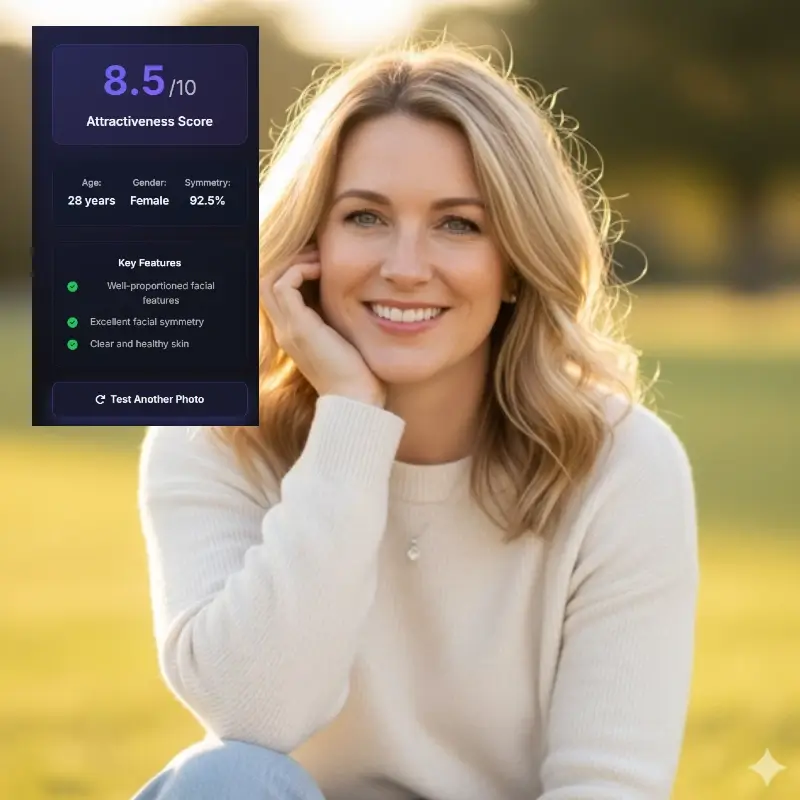
An AI face rating system often pays attention to how balanced the two sides of the face appear in the uploaded photo and how visible landmarks line up across the frame. This does not mean perfect symmetry is the whole story, but it is one of the most common cues used in face rating AI systems.
The system also tends to estimate proportions among the eyes, nose, lips, forehead, and chin. A face rater AI is usually looking for patterns that training data associated with stronger visual appeal, but those patterns are only one layer of attractiveness and can vary by dataset.
Many users assume only bone structure matters, yet AI face rating is also affected by visible surface information. Skin texture, lighting smoothness, contrast, sharpness, and expression all shape how the uploaded image is interpreted. This is one reason a soft natural-light portrait can outperform a harsh bathroom selfie.
The model needs to read the eyes, nose, lips, and facial outline clearly before it can produce a stable AI face rating.
Symmetry cues can change depending on head turn, camera tilt, shadows, and whether part of the face is hidden.
The score often reflects spacing and relative balance across features rather than one single measurement.
A blurry or noisy photo can lower confidence and make the face rating score less consistent.
Face Rating AI is an image-based tool that estimates a face score from a photo by reading visible cues such as symmetry, proportions, balance, and image presentation. It is best used as feedback on a submitted photo, not as a complete measure of real-world attractiveness.
Most AI face rating systems detect a face, locate visible landmarks, estimate spacing and symmetry, and then combine those signals with image-quality cues to generate a score. The exact scoring method varies across tools, so results can differ between platforms.
Face Rating AI can be useful for comparing photos, but the score is not perfectly objective. Accuracy depends on the uploaded image, the model, and the data used to train it. A clean, front-facing photo usually gives a more stable result than a dark, blurred, or angled selfie.
AI face rating tools judge images, not your permanent face. Lighting, head angle, camera distance, expression, crop, and filters can all change how the model reads the same person.
Use a clear portrait with even light, a visible full face, and minimal filters. A front-facing selfie or headshot usually works best because the model can read landmark spacing and symmetry more consistently.
Yes. That is one of the best use cases for AI face rating. Compare several strong photos and look for the image that consistently presents your face clearly and confidently.
No. It usually means that one photo did not perform strongly under one scoring model. Real-life attraction includes style, warmth, confidence, body language, and personal preference, none of which can be fully captured by a still image.
Absolutely. Before using any face rater AI, review whether the site stores uploaded images, uses them for model training, or shares them with third parties. Privacy and data handling are part of the quality of the tool, not a separate concern.
Not exactly. A face rating score summarizes how one image matches a model's visual cues, while an attractiveness score may use a broader scoring label. Both are photo feedback, not a complete judgment of a person.